
Your Intake Form May Be Missing What Matters Most
By Mialisa Garnes, Founder of The Wellness Growth Agency
When I asked Dr. Maria Zalazar, Founder and CEO of MZ Medical, what her work meant for clinic owners and practitioners, she brought the conversation back to time with the patient.
She talked about asking beyond symptoms. About work. Relationships. What was changing in a woman’s life.
It made me think about the information a clinic collects before that woman ever walks through the door.
You may have a detailed intake form. You may know her medical history, current medications, and the symptoms she wants to discuss.
Does your team also know what she is most worried about losing, struggling to manage, or hoping to get back?
For a clinic serving women in perimenopause and menopause, that context deserves a place in the patient experience.
A symptom list is the beginning of a conversation.
In my conversation with Dr. Janet Williams, we discussed desire in the context of women’s wider lives. She spoke about responsibilities, relationships, children, ageing parents and demanding careers. She also described the pressure that shorter appointments can place on a clinician’s ability to listen.
The connection between those conversations is useful for clinic owners.
A woman may select “poor sleep” on a form. What she most wants to explain is that she no longer trusts herself to get through an important meeting. She may select “low libido” while wondering how to talk about the strain in her relationship.
These are illustrative examples, not diagnoses. They show the difference between recording a concern and understanding why it matters to the person seeking help.
The clinician makes the clinical assessment. Your patient experience should help the woman bring the relevant context into that conversation.
What the research adds to the conversation
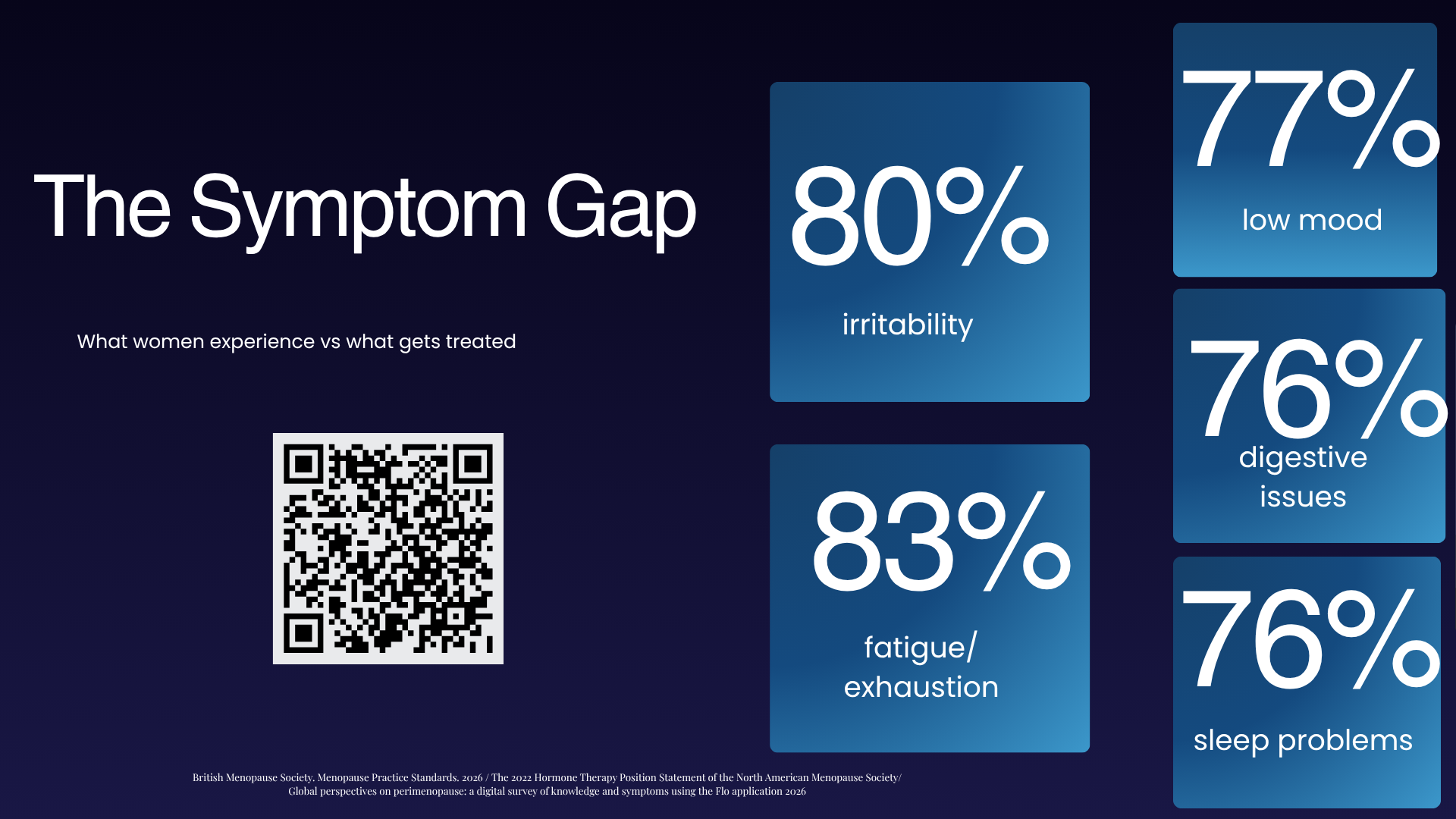
One of the slides Dr. Maria shared shows a range of reported symptoms. In the Flo survey, 83% of respondents aged 35 and over reported fatigue and 80% reported irritability. These figures describe that survey group, not the prevalence of confirmed perimenopause in the general population.
For your clinic, the practical question is what space your intake process gives a woman to explain her experience in her own words, before a clinician assesses it.
Work can be part of the reason she seeks help.
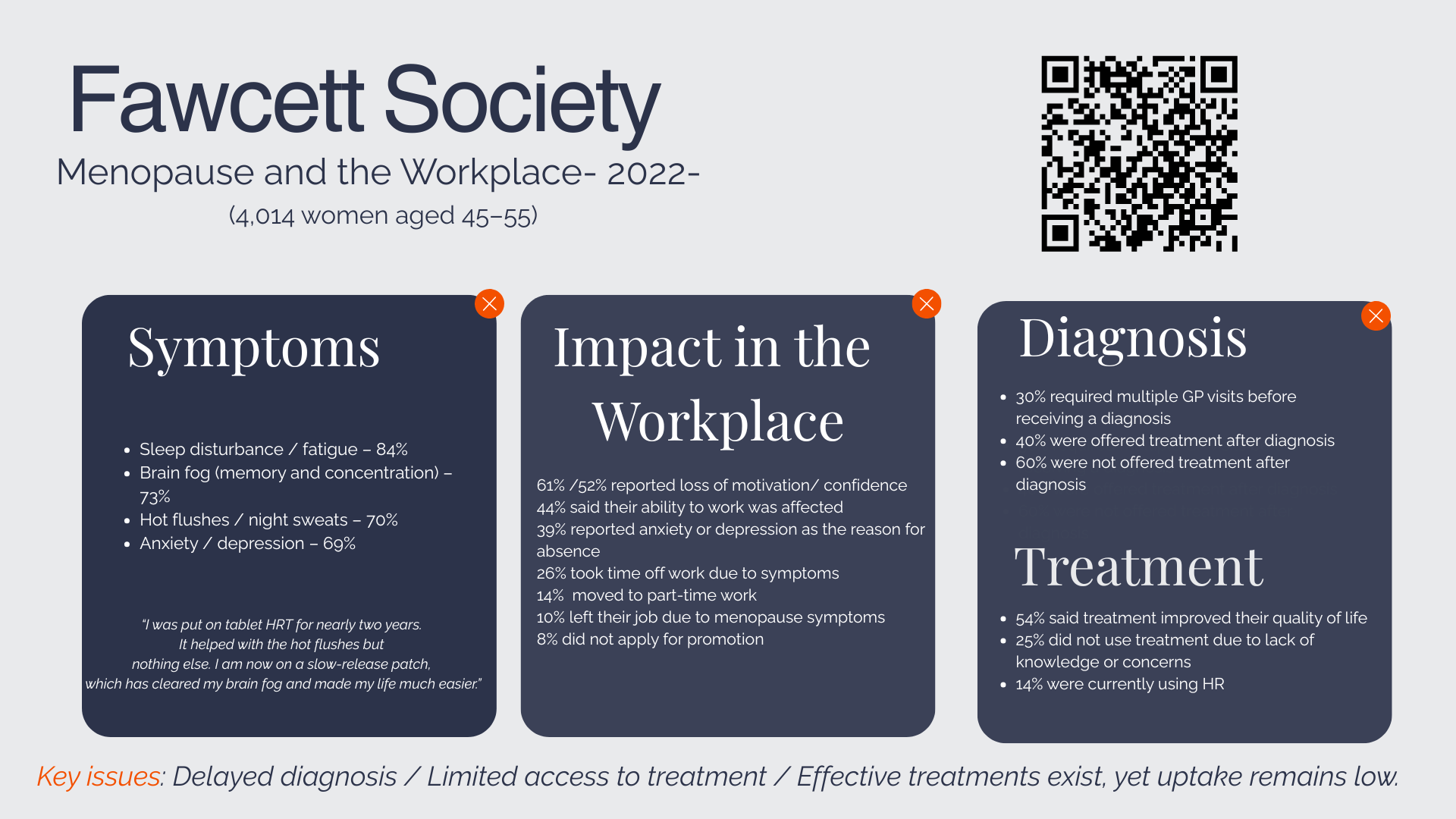
The Fawcett Society’s 2022 research surveyed 4,014 UK women aged 45 to 55 who were experiencing or had experienced perimenopause or menopause. Among respondents who had worked during menopause, one in ten reported leaving a job because of symptoms.
That is a finding from a specific UK survey. It gives weight to asking about working life, without assuming that every woman’s situation has the same cause or consequence.
Read the Fawcett Society report.
A symptom checkbox may tell you what she is experiencing. A conversation about work, relationships and daily life can help reveal what she most wants help understanding.
Ask what she wants help understanding.
Adding more questions is not automatically an improvement.
If a patient already faces a long form, another page of required answers may make it harder to complete. Start by examining what you ask, what you actually use, and what could be discussed more appropriately in person.
A small number of purposeful questions can create a useful opening.
“What has changed in your day-to-day life that you would most like us to understand?”
“What would you most like help with at this appointment?”
“Is there anything you would prefer to discuss privately with your clinician?”
These are suggested prompts for your clinical team to review and adapt. They should support the consultation, with room for a patient to skip a sensitive written answer and speak instead.
You are inviting context. You are not asking her to diagnose herself before she arrives.
Explain why you are asking.
Questions about work, relationships or sexual wellbeing can feel personal. They are personal.
In her podcast conversation, Dr. Peggy Margetson described explaining why she asks certain questions, recognising that she may have only just met the woman in front of her. That principle belongs in the intake experience too.
Tell patients how the information will help prepare for their appointment. Use the clinic’s appropriate confidential channel. Make it clear when a question is optional and when a conversation with the clinician may be more suitable.
Do not collect intimate detail simply because your software allows another field. Every question should have a purpose, an appropriate place, and someone responsible for using the answer.
Show her that somebody read it.
A patient can spend twenty minutes carefully explaining herself and still arrive at a conversation that makes her wonder whether anyone looked. That is an experience problem worth investigating.
Before adding anything to your intake form, decide how the answers reach the clinician. Who reviews them? When? How are the patient’s priorities made visible?
A simple acknowledgement can make that preparation tangible.
“You mentioned that the changes at work are worrying you most. Let’s make sure we talk about that today.”
That example does not promise an immediate explanation or outcome. It demonstrates that her effort to communicate has reached someone.
Real and truly, asking women to tell us more creates a responsibility to pay attention to what they say.
Carry her priorities into the next conversation
Useful context should not disappear after the first appointment.
Where relevant to her care, the concerns she identified can inform the follow-up conversation. Has the situation changed? Is the original priority still the one she wants to address? Has something else become more pressing?
The clinical team decides what should be assessed. The operational task is to make relevant information accessible so the patient does not have to reconstruct the entire story at every contact.
That is where intake becomes part of a connected patient experience.
Review the questions and the process together
Take your current intake form and follow it through the clinic.
Identify the questions that help prepare the consultation. Notice where patients repeat information, where sensitive answers are requested without explanation, and where important responses are difficult for the clinician to find.
Then choose one improvement your team can use consistently.
The goal is a better-prepared conversation, with the woman’s priorities visible alongside the clinical information.
A form can help make that possible. Its value depends on what happens after she presses submit.
Find the gaps around your first visit.
The Patient Experience Gap Report helps you review the experience from booking through follow-up, including the points where preparation and clarity can break down.
GET THE PATIENT EXPERIENCE GAP REPORT
Hear the conversations behind this article.
Watch The Menopause Penalty Is Real with Dr. Maria Zalazar and Why Don’t I Like Sex Anymore? The Real Reasons Libido Changes After 40 with Dr. Janet Williams on the Wellness & Growth Journeys podcast.


